 Muse AI
 Grok Bot
 ChatGPT

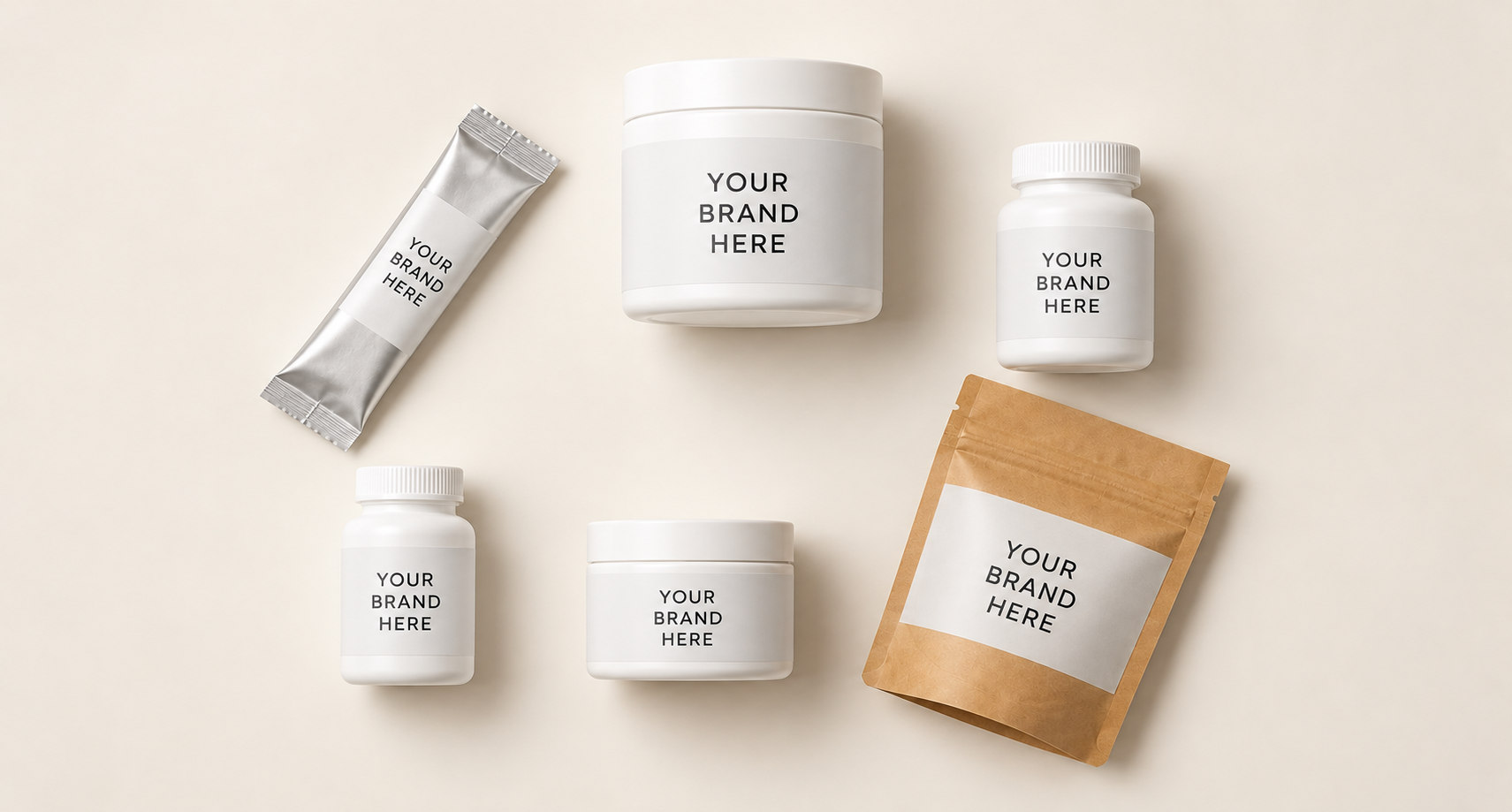
The same powder can reach a customer in a jar, in single serving stick packs or in a resealable pouch. The format changes how people use the product, what it costs to ship and how much room you have for a label. For a first launch, pick the one that matches how your customers will really use it.
The three formats at a glance
| Jar | Stick packs | Pouch | |
|---|---|---|---|
| How it is used | Scoop at home or at the gym | Tear and pour, one serving | Scoop from a resealable bag |
| Good for | Daily use. Shelf display | Travel, sampling, events | Refills. Light shipping |
| Serving control | Depends on the scoop | Measured for you | Depends on the scoop |
| Label space | A full wrap label | Small on each stick, more on the box | Front and back panels |
| Shipping | Bulky but sturdy | Compact. Boxes pack well | Light and flat. Can be punctured |
| After opening | The lid closes easily | Nothing to reseal | The zipper must be closed well |
| Watch for | Size and weight in the mail | More packaging per serving | Stands less neatly on a shelf |
Questions that point to a format
Where will the customer be when they use it?
At a kitchen counter, a jar is easy. In a gym bag, at a desk or on a plane, a stick pack wins.
How will people first try it?
If trial matters, stick packs let someone try one serving without buying a whole jar. They are easy to hand out at an event or tuck into another order.
How will you ship it?
If most orders go by mail, weigh a filled jar and a filled pouch of the same size, then price the postage for each. The difference can change your margin.
How much do you need to say on the pack?
Required label information takes room. FDA's dietary supplement labeling guide lists five statements that containers and packages must carry, including the Supplement Facts panel and the ingredient list. On a small format, plan where those will go before you fall in love with a design.
What feels right for your price?
A jar on a shelf looks like a full product. A pouch can read as a refill or a value option. A box of sticks reads as convenient. None of these is wrong. Match the format to the story you tell.
A made up example
Dev coaches a running club and wants a drink mix under the club's name. Runners would use it before early runs, often straight from the car.
- Use: away from home, one serving at a time. That points to stick packs.
- Trial: he wants every member to try it once. Stick packs again.
- Simplicity: he wants an easy first order with one label to approve. That points to a jar.
Dev starts with jars sold at the club table, because it is the simpler first step. He plans stick packs as his second product once he sees steady reorders. Starting with sticks would also have been reasonable. What mattered was choosing one and learning from it.
Start with one
Each format has its own packaging, its own label and its own minimum. Launching all three at once triples your decisions and splits your sales. Pick one, sell through it, then add the next.
Ask for a price per serving
When you compare quotes across formats, ask for the cost per serving as well as per unit. A jar of 30 servings and a box of 15 sticks are not the same amount of product.
Formats at OSM
OSM's custom manufacturing covers powders in jars, stick packs and pouches. The white label range is offered in jars. If you are not sure which format suits your product, describe how your customers will use it when you request a quote.
Common questions
Can the same powder go into all three?
Often, but not always. How a powder flows and how much fits in one serving both matter. Ask your manufacturer.
Are stick packs harder to produce?
They involve more packaging steps than filling a jar. Whether that changes your price or timing depends on the quote.
Which is better for the environment?
It depends on the materials and on local recycling. If this matters to your customers, ask what each package is made of, and say only what you can back up.